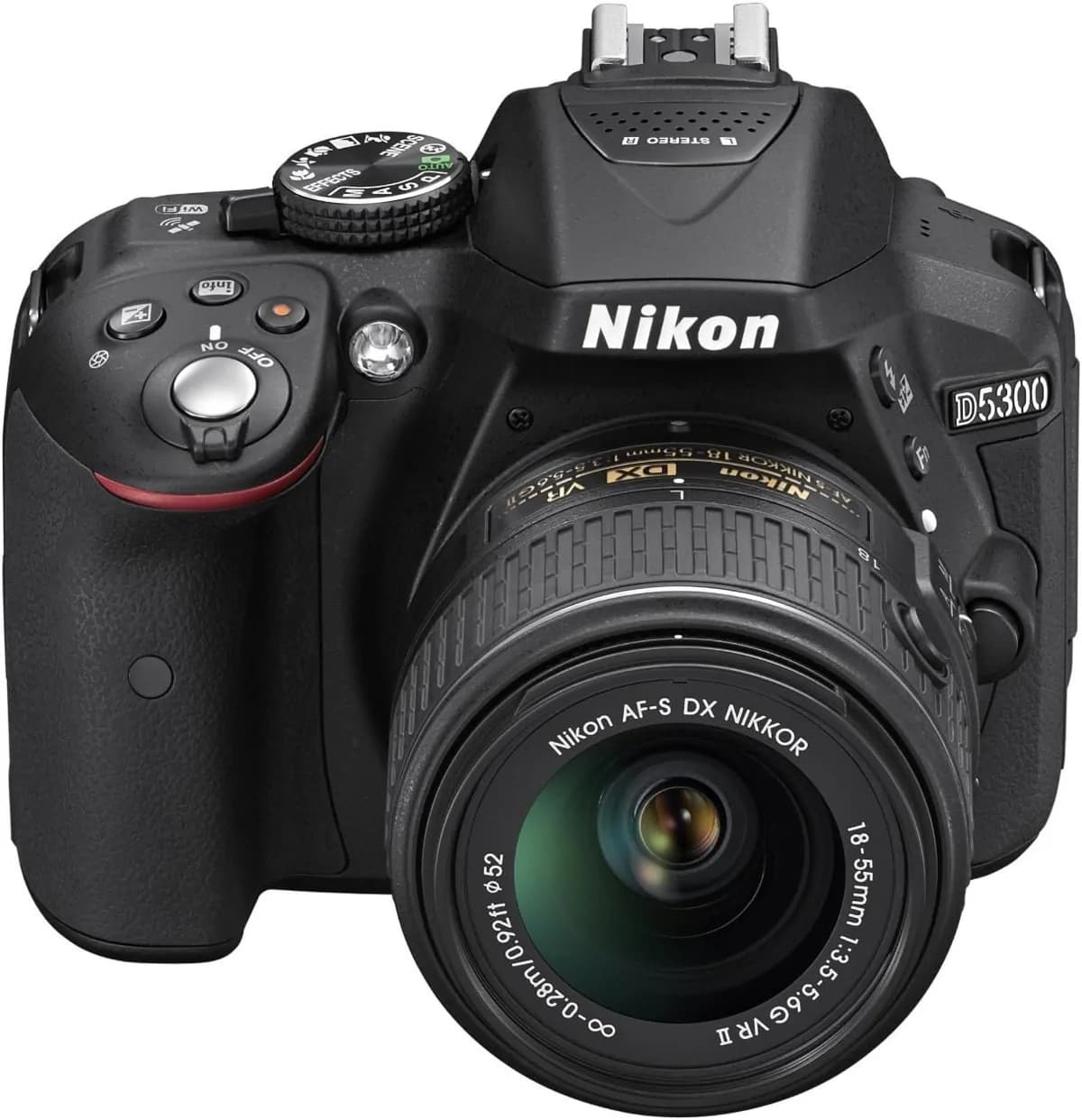
The black Nikon D5300 DSLR Camera features a DX-format 24.2 megapixel sensor and EXPEED 4 image processor to produce high-resolution still imagery and full HD video with notable low-light sensitivity to ISO 12800 and a fast continuous shooting rate of 5 fps. The sensor design omits the traditional optical low-pass filter in order to gain the utmost sharpness and resolution from both photos and videos. Complementing the imaging assets are both a versatile 39-point autofocus system, with nine cross-type sensors, and a 2,016-pixel RGB sensor for precise exposure metering in a wide variety of lighting conditions. Additionally, 1920 x 1080p movie recording is supported, in multiple frame rates up to 60 fps, with full-time continuous auto focusing capabilities. The compact, yet durably designed, camera body incorporates both an optical pentamirror optical viewfinder along with a large 3.2″ 1,037k-dot vari-angle LCD monitor, which features a 180° swivel design to better support working from high and low angles. Also integrated into the D5300 are both Wi-Fi and GPS modules, which enable advanced image sharing capabilities as well as location-based image tagging. When paired with an Android or iOS mobile device, remote viewing and control over the shutter release is possible from a distance and a vast network of pre-populated Points of Interest adds to the overall geotagging functionality. For creatively enhancing the look and feel of imagery in-camera, a wide range of Picture Control modes, Scene Modes, and Special Effects modes are available as well as a host of in-camera image editing capabilities for adjusting settings prior to sharing. Built-in HDR and Active D-Lighting modes can also be used to optimize exposure results by preserving highlight and shadow details for an extended range of apparent tones.
The Nikon DSLR Camera features a 2.7-inch 230,000-dot resolution tilt-and-swivel LCD monitor (D90 is 3.0-inch (76 mm), 920,000 pixel, without swivel or tilt), live view, ISO 200–3200 (100–6400 with Boost), 3D tracking Multi-CAM1000 11-point AF system, active D-Lighting system and automatic correction of lateral chromatic aberration
The D5300 incorporates an amazing array of special effects for use when taking still pictures or recording D-Movie Full HD movies. Selective Color isolates color within the scene, capture details in places too dark for your own eyes using Night Vision, create bright, glowing images filled with atmosphere with High Key, emphasize the mood of a scene using Low Key, Miniature Effect makes a scene look like a miniature scale model and Color Sketch creates color outlines of the subject that are played back as a series of stills in a slide show.The arrival of the D5300 appears to signal the completion of Nikons refresh of its non-pro DSLR lineup. Its feature set and pricing mean that it sits very comfortably between the beginner-friendly D3100 and the high-end D7000 - it's clearly aimed to attract the attention of enthusiast photographers without cannibalizing sales of is sister models. A camera maker can judge the success of its market positioning by seeing how many people are wondering 'which model is right for me?' on discussion forums - and we think a D3100/D5100/D7000 progression would minimize such doubts. The official line is that the D90 maintains its position in the range, but both its naming and overlap with other models suggest that its role is now more one of historical interest than future significance.
The D5300 has a very similar 16.2MP CMOS sensor to the excellent one seen in the D7000 but, understandably, loses out on that camera's high-end build and feature-set. So there's no wireless flash control, magnesium alloy build or 39-point AF system but the underlying image quality is all but identical.
It has become standard for a Nikon at this price point, the D5300 offers a single control dial, pentamirror viewfinder and no built-in autofocus motor. However, it gains 1080p video capability (at 30, 25 or 24fps), saved using the efficient H.264/AVC codec, and a 920,000 dot fully articulated LCD panel to help shoot it. These are both significant gains over its predecessor the D5000, and the improvements extend to the D5000 having smaller, neater construction and a more conventional side-mounted hinge for that LCD.
These changes resolve two rather awkward aspects of Nikon's existing lineup: if the D5000 and D7000 end up being neighboring models it will avoid the inelegant overlap that existed between the D5000 and D90. It also ensures a more elegant appearance to the models themselves (the D5000 was many things, but pretty wasn't one of them).